


+44 (0) 7525819278
WORKSHOPS
We offer workshops tailored to artists, institutions, universities, and creative communities, drawing on extensive experience in photography, documentation, immersive technologies, and accessibility.
Led by Studio Radar’s directors, who have worked widely as guest teachers in higher education, our workshops foster dialogue, experimentation, and critical engagement with visual practices.
HERE A LIST OF WORKSHOPS WE OFFER:
360º Filming and Photography
This workshop is designed for video makers of all experience levels who are interested in exploring the creative possibilities of 360-degree filmmaking and immersive storytelling.
Available in one, two, or three-day formats, the course covers the full production workflow: from developing concepts and storyboards for 360° narratives, to camera operation, ambisonic sound recording, post-production editing and stitching, and final export for screenings or VR headsets.
 |  |  |  |
|---|---|---|---|
 |  |  |
Performing for the camera
In recent years, interdisciplinary approaches have become a vital source of innovation in artistic research. This workshop focuses on the dynamic and complex relationship between Photography and Performance Art.
Building on twenty-five years of professional practice and a PhD dedicated to the subject, Manuel Vason has developed a set of key questions and hands-on exercises to help students expand their skills and perspectives. The workshop invites participants to perform with and for the camera, while developing new methodologies for their artistic practice.
 |  |  |
|---|---|---|
 |  |  |
 |  |  |
 |  |
‘My students have really enjoyed the workshop and have continued to practice performance for camera throughout the year.’
Gavin Butt
(Attemborough Chair in Theatre and Performance at University of Sussex)
Community Arts Projects
This participatory arts workshop explores the transformative potential of art as a means of support and empowerment for vulnerable, and disadvantaged communities.
Through photography—used as a playful and poetic tool for identity-making/shifting—the group is invited to perform intimacy and reshape collective memories.
 |  |  |
|---|---|---|
 |  |  |
 |  |  |
 |  |  |
 |  |
Unframing Photography
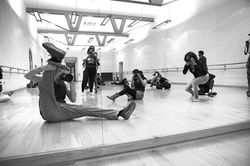
This workshop approaches photography as a performative practice. Emphasizing the photographic action over the final image, the group is invited to experience the camera as a companion—one that enables new ways of looking both inward and outward.
The course explores the photographic pose as a transformative process grounded in stillness, and as a contemplative exercise that reveals the power dynamics embedded in the act of looking.
 |  |  |
|---|---|---|
 |  |  |
 |  |
Preparing the Ground
Preparing the Ground is a workshop that invites participants to cultivate somatic awareness as a foundation for artistic practice. The title refers both to the act of caring for soil before planting and to the creation of symbolic and material conditions in which ideas, projects, and imaginaries can emerge. Here, the “ground” is understood as the field of artistic practice itself: alive, mutable, and shaped through the ongoing negotiation between body, language, matter, and desire.
Drawing on her research in performance, Rubiane Maia proposes the creation of diagrams as intuitive and reflective devices for reading artistic processes. These diagrams function as oracular tools, capable of articulating energy flows, gestures, temporalities, and layers of otherness, offering participants new perspectives on their creative trajectories.
The workshop provides sensitive methodologies for mapping motivations, reorienting modes of production, and imagining possible futures for artistic research. Conceived as an open and transformative space, Preparing the Ground can be delivered in group settings or adapted for one-to-one mentoring, supporting artists and creatives at different stages of their practice.
Let’s Talk About Care?!
Let’s Talk About Care?! is a group-based workshop that creates a shared, attentive space for reflection and dialogue around care as a lived, social, and political practice. Rather than seeking fixed definitions, the workshop invites participants to explore how care operates across personal experience, professional contexts, and collective life.
The methodology is guided by 220 Questions About Care, a work developed by Rubiane Maia in 2023 and presented in the form of an oracular card deck. Through a game-like dynamic, participants draw cards that open conversations, introduce friction, and surface themes that are sometimes tender, sometimes challenging. The cards function as prompts rather than answers, activating listening, exchange, and critical reflection within the group.
This workshop is not limited to artists. It is designed for groups of people who engage with care on an individual or professional level, including caregivers, educators, health and social workers, facilitators, cultural workers, community organisers, and others whose practices are shaped by responsibility, attention, and relational labour. In a post-pandemic context, where care has become inseparable from questions of mental health, social justice, healing, and repair, the workshop offers a collective space to pause, articulate, and rethink how care is practised, shared, and sustained.